China Top 10 Patio Doors UK Manufacturers for Global Buyers

Choosing a supplier for patio doors uk projects involves more than comparing catalogue prices. Global buyers need clear specifications, dependable production, and communication that continues after an order is placed. This guide introduces ten Chinese manufacturers for buyers exploring patio door options for the UK market. It is a starting point, not a certified ranking.

A useful comparison looks beyond attractive photographs. Check frame materials, glazing choices, thermal performance, opening styles, hardware, and available sizes. Ask for recent product documentation and confirm which requirements apply to your project with qualified professionals. Details matter. A smooth-sliding sample can feel reassuring, but it cannot show how every unit will perform after shipping and installation.

Lead times, packaging, warranty terms, and replacement-part support deserve equal attention. Request written answers, review sample labels, and clarify how custom dimensions affect cost and delivery. A polished catalogue is not proof of consistent production. Nor does a low quotation explain every charge. Some supplier information may be difficult to compare directly, so buyers should record assumptions and ask follow-up questions. That extra work can feel tedious. It is still worthwhile. The manufacturers profiled here offer a practical shortlist for further checks, not a substitute for factory verification, technical review, or project-specific due diligence.
China Top 10 Patio Doors UK Manufacturers for Global Buyers

Understanding the UK Patio Door Market and Its Main Product Types

The UK patio-door market reflects varied homes, from compact terraces to wide suburban extensions. The English Housing Survey 2022–23 estimates 24.4 million households in England, with around 65% owner-occupied. This is a housing baseline, not a patio-door sales count. Still useful. Owner-occupiers may consider doors during renovations, while builders often specify them for new extensions. Product choice depends on opening width, available wall space, access needs, and exposure to rain and wind.

Sliding doors suit rooms where outward-swinging panels would obstruct furniture or patios. Their broad glass panels admit daylight, but check frame sightlines and track drainage.

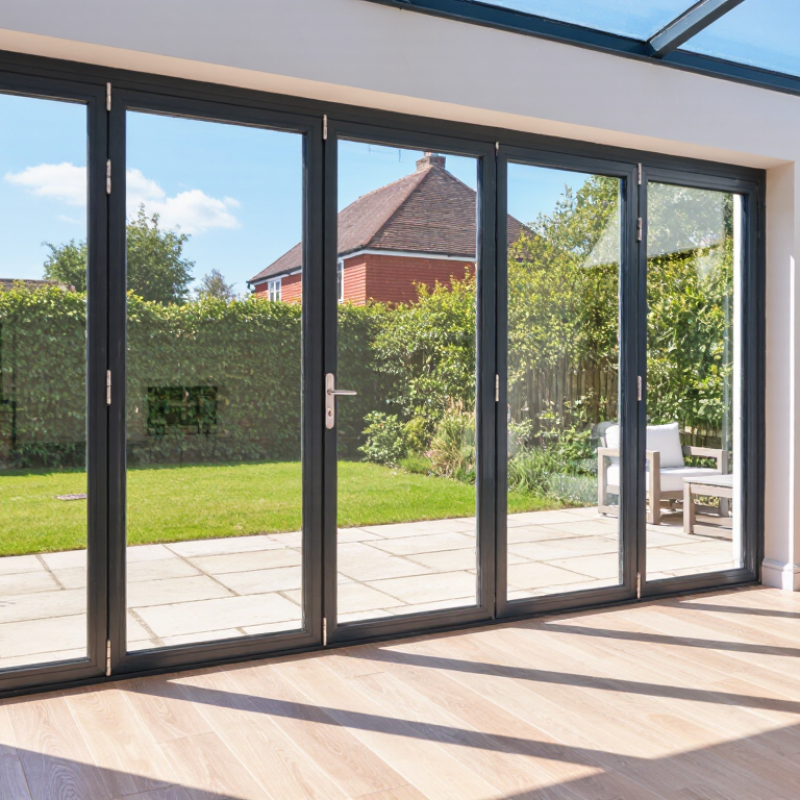
Bifold doors fold into a stack, creating a wide opening; however, the stacked panels need parking space. French doors offer a familiar, smaller opening, though their swing requires clearance.

Lift-and-slide systems can handle larger panels, but usually involve more complex hardware and installation. The UK government’s Approved Document L sets energy-efficiency requirements for replacement doors and new homes. Buyers should compare tested whole-door thermal performance, not glass figures alone.

Installation matters. A poorly sealed threshold can undermine an otherwise capable door. These distinctions are easy to overlook.

How to Evaluate Chinese Patio Door Manufacturers for UK Projects

For a UK patio-door project, assess a Chinese manufacturer through verifiable performance, not catalogue claims. Request current test reports for the exact door configuration, including its frame, glass, seals, and hardware. Reports for a similar model may not prove the proposed system performs the same way. Check air leakage, water penetration, and wind resistance against the project specification. Confirm applicable UK requirements with your project professional. Small details matter. Look closely at drainage slots, corner joints, and seal contact around the frame.

Ask for production drawings, material specifications, and a clear schedule for samples and delivery. Inspect a sample by opening and closing it repeatedly; note any rubbing, uneven gaps, or loose handles. Confirm how replacement hardware and spare parts will be supplied after installation. Request references for projects with similar exposure and building conditions, rather than relying only on polished photographs. Packaging also deserves attention: glass and frame damage during a long shipment can disrupt site work. Even a thorough checklist can miss something, so record agreed tolerances and responsibilities in writing before production begins.

China Top 10 Patio Doors UK Manufacturers for Global Buyers - How to Evaluate Chinese Patio Door Manufacturers for UK Projects

Evaluation criterion Relevance to UK projects Information to request from a manufacturer How to assess it
1. UK regulatory suitability Building requirements vary by project location and building type. England, Wales, Scotland and Northern Ireland have separate building regulations and guidance. A proposed product specification, relevant test or assessment reports, and a written explanation of how the doorset is intended to meet the project’s applicable requirements. Have the project designer or building-control professional review the complete doorset specification for the site and intended use.
2. Thermal performance Heat-loss requirements depend on the project, building type and applicable regulations. Whole-door performance can differ from the glass-only value. A declared thermal transmittance value (U-value) for the complete doorset, with the calculation or test method, dimensions, glazing configuration and frame details identified. Compare the whole-product value with the project specification; do not use a centre-of-glass value as the whole-door U-value.
3. Air permeability Air leakage can affect comfort, energy use and draught control. EN 12207 provides classification for air permeability of windows and doors. A test report stating the classification, tested specimen size, opening configuration, seals and hardware used. Confirm that the tested configuration is representative of the patio door being quoted and meets the project brief.
4. Watertightness Exposure to wind-driven rain varies with location, building height and installation details. EN 12208 classifies watertightness performance. A watertightness test report, including the reported class, specimen details, threshold arrangement and test conditions. Check that the test configuration matches the proposed system and that the installation design provides suitable drainage and weather sealing.
5. Wind-load resistance Required resistance depends on site exposure, building height, location and the project’s structural design. EN 12210 provides wind-load classifications. A test report or engineering evidence identifying the wind-load class, specimen dimensions, frame support and any deflection results. Ask the project structural designer to confirm that the declared performance is suitable for the site-specific design loads.
6. Security and locking Security needs depend on the building and project specification. PAS 24 is a UK security test standard used for doorsets and windows in relevant applications. Details of the locking system, cylinder and hardware, plus any applicable third-party certification or test evidence for the complete doorset. Verify the scope of any certificate: product type, dimensions, hardware, glazing and installation conditions should match the proposed specification.
7. Safety glazing Glazing in doors and other critical locations may need to meet safety-glazing requirements under the applicable building guidance and project design. Glass build-up, safety-glass type, thickness and supporting product documentation. Common relevant product standards include BS EN 12150 for thermally toughened glass and BS EN 14449 for laminated glass. Confirm the glazing type and location-specific safety requirements with the project designer; check that the supplied glass matches the approved specification.
8. Accessibility and thresholds Access requirements depend on the building’s use and applicable regulations. Threshold height, clear opening width and operating effort can affect usability. Threshold and sill dimensions, clear opening details, handle and operating information, and drawings showing the finished floor interface. Review the opening and threshold details against the project’s accessibility brief and the relevant local building guidance.
9. Durability and finish Coastal exposure, pollution, moisture and frequency of use can influence the service life of frames, finishes, seals and hardware. Frame and finish specifications, hardware material and corrosion information, seal replacement details, maintenance guidance and warranty terms. Match materials and maintenance needs to the site environment; review warranty exclusions, especially for coastal or high-exposure locations.
10. Quality control and export readiness Consistent production, accurate dimensions and complete shipping documents help reduce site delays, damage and installation problems. Factory quality-control procedures, dimensional inspection records, packaging plan, production lead time, sample approval process and agreed shipping documents and delivery terms. Approve production drawings and samples before manufacture; agree inspection points, packaging requirements, responsibilities and delivery terms in writing.

China’s Top 10 Patio Door Manufacturers for UK Buyers

China’s Top 10 Patio Door Manufacturers for UK Buyers should be judged by evidence, not catalogue images. Ask each shortlisted factory for whole-door thermal data, air-leakage results, water-penetration tests, and wind-load reports. Check that test samples match the proposed frame, glass, hardware, and opening size. Small changes matter. A test report for one configuration may not cover another.

The International Energy Agency’s 2023 Global Status Report for Buildings and Construction estimates that building operations use about 30% of global final energy and produce 26% of energy-related emissions. That makes insulation and airtightness more than sales language. Compare whole-door U-values, threshold details, and thermal-break design against the project specification. Request test evidence from accredited laboratories, plus drawings showing drainage and installation clearances. Details matter.

For UK buyers, the top ten should also be assessed on production consistency, packaging, lead times, spare-part access, and clear warranty terms. Ask how the supplier handles a damaged glass unit or a misaligned sliding panel after delivery. Get answers in writing. A polished sample is useful, but it cannot reveal every site issue. I would still allow time for an independent technical review; it may feel cautious, yet patio doors are large, exposed products.

England’s New-Dwelling U-Value Limits: Patio Doors in Context

Maximum permitted U-values for selected building elements in new dwellings under England’s Approved Document L. A lower U-value indicates better thermal insulation.

The 1.6 W/m²K limit applies to windows and doors, including patio doors. These are regulatory maximums, not product ratings or manufacturer comparisons. Source: England Approved Document L, Volume 1.

Comparing Door Materials, Designs, Performance, and Customisation

For UK buyers comparing patio doors from Chinese manufacturers, material choice affects more than appearance. Aluminium frames can support broad glass panels and slim sightlines, but thermal breaks and frame depth need checking. uPVC often offers practical insulation and low maintenance, though thicker profiles may reduce visible glass. Timber brings warmth and can suit traditional homes, yet finishes and upkeep deserve careful discussion. No material wins every project.

Design should fit the opening and how people use the room. Sliding doors save indoor space, while folding systems create a wider opening but need room to stack. Check threshold height, drainage details, locking points, and handle placement. These small details matter. Ask for drawings showing the actual configuration, not just a showroom image. A polished picture can hide awkward clearances.

Performance claims are useful only when tied to test reports for the specified door size and glass build-up. Request U-values, air and water performance data, and confirmation of applicable UK project requirements. Customisation may cover colours, glazing, hardware, panel sizes, and opening direction. Specify each item in writing, including tolerances and packaging. One thing is easy to miss: a custom finish can affect lead time, and that should be confirmed before ordering.

Assessing Export, Compliance, Delivery, and After-Sales Support

For UK buyers comparing Chinese patio-door manufacturers, export readiness means more than a low FOB quote. The World Bank’s 2023 Logistics Performance Index ranked China 19th among 139 economies. Useful context, not a shipment guarantee. Ask for UK-bound references, packing photos, agreed Incoterms, and a named contact for customs documents. Confirm production lead times against vessel cut-offs, then allow for port handling and inland delivery. Small omissions matter. A missing hardware schedule can delay installation.

Check compliance for the exact door configuration. Request test evidence and performance declarations against BS EN 14351-1, plus confirmation of the marking and documentation route applicable in Great Britain. Have a UK importer or technical assessor verify current requirements. The U.S. Department of Energy estimates that windows account for 25–30% of residential heating and cooling energy use; this is not a patio-door specification, but it shows why thermal performance deserves scrutiny. Ask for declared U-values and air- and water-tightness results. After-sales support needs equal attention: specify spare rollers, handles, seals, warranty coverage, and response times in writing. Get it in writing. A warranty can sound reassuring while the spare-parts plan remains vague.